A cultural field guide · The northern manuscripts
The Norse Worlds
Beyond the halls of gods and men, serpents coil beneath the world-tree, wolves pursue the sun, and the dead sail from the north.
Reading the evidence. Medieval sources preserve different voices, often written down in Christian Iceland after the conversion. Modern reconstructions, our thematic groupings and later art are interpretations, not a single recovered Norse canon.
The World and its Sources
Begin with a tree, not a map. In the Eddic sources, Yggdrasil connects places inhabited by gods, humans and other beings. The accounts do not supply one consistent illustrated atlas; familiar modern diagrams make choices the texts leave open.
This guide follows named witnesses rather than treating every northern story as interchangeable. “Giant”, “elf” and “dwarf” are useful English headings, but their boundaries are not those of a modern biological classification. The shelves below are editorial ways into the texts.
Gods and Divine Beings
The Æsir and Vanir belong to a world of kinship, bargains and conflict. Divine figures share the narrative with beings who become their relatives, helpers or opponents; the categories overlap.
Divine being · Æsir
Óðinn
A seeker of knowledge whose ravens carry news of the world. His encounters show how closely wisdom and danger are joined.
- Realm / setting
- Ásgarðr; journeys beyond the gods’ halls
- Source status
- Medieval textual account
Giants and Primordial Creatures
The jötnar are more than enormous adversaries. The creation account places them at the beginning of the world; later narratives make them kin as well as rivals of the gods. This shelf also gathers the great wolf Fenrir as a primordial threat, without calling him a jötunn.
Primordial being · Jötunn
Ymir
In Snorri’s creation account, Ymir emerges where cold and heat meet. The gods later fashion the world from his body.
- Realm / setting
- Ginnungagap
- Attested in
- Gylfaginning, creation narrative
- Source status
- Medieval textual account

Monstrous wolf
Fenrir
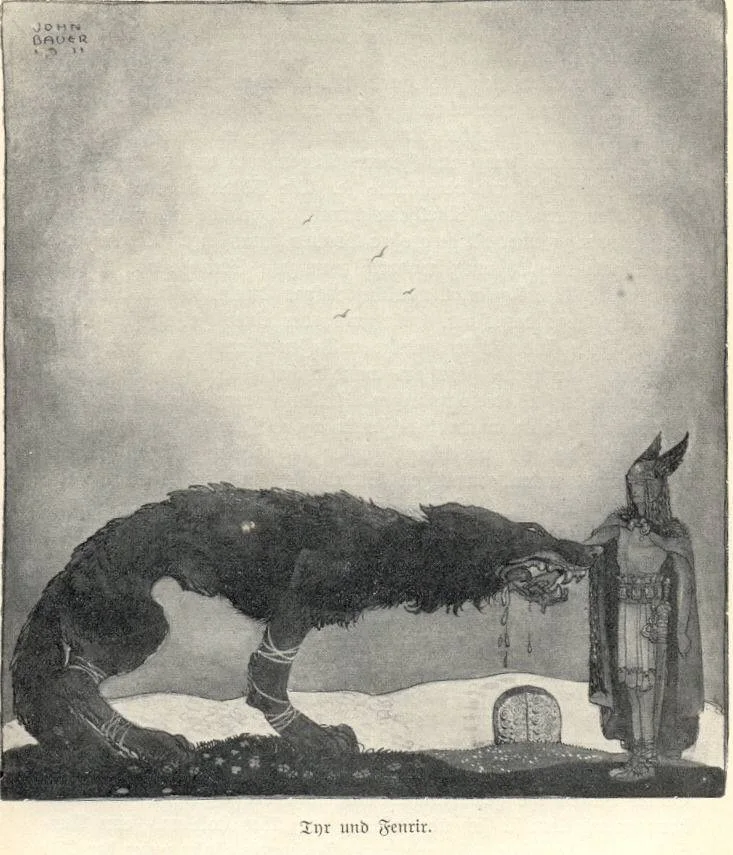
The wolf breaks the gods’ fetters until they bind him with Gleipnir. Týr loses a hand in the bargain.
- Realm / setting
- The island of Lyngvi
- Attested in
- Gylfaginning, the binding of Fenrir
- Source status
- Medieval textual account
Dragons and Serpents
Serpentine beings inhabit different kinds of narrative: the cosmic tree and the heroic treasure-hoard are separate settings. Their forms should be read from each source, not inferred from later winged-dragon illustrations.
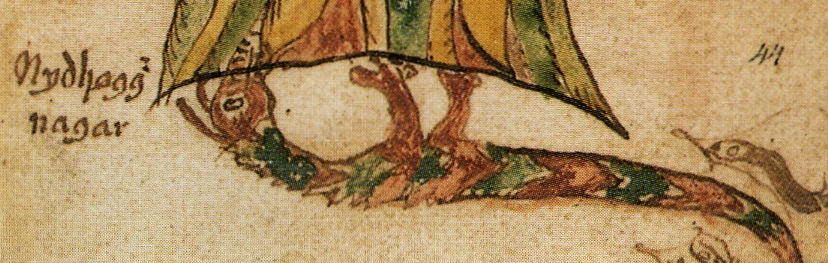

Dragon / serpent
Níðhöggr
A being associated with Yggdrasil’s roots and with the dead. The poems and Snorri preserve related but distinct descriptions.
- Realm / setting
- Yggdrasil; the world below
- Attested in
- Grímnismál 32, 35; Völuspá 39, 66
- Source status
- Medieval textual account
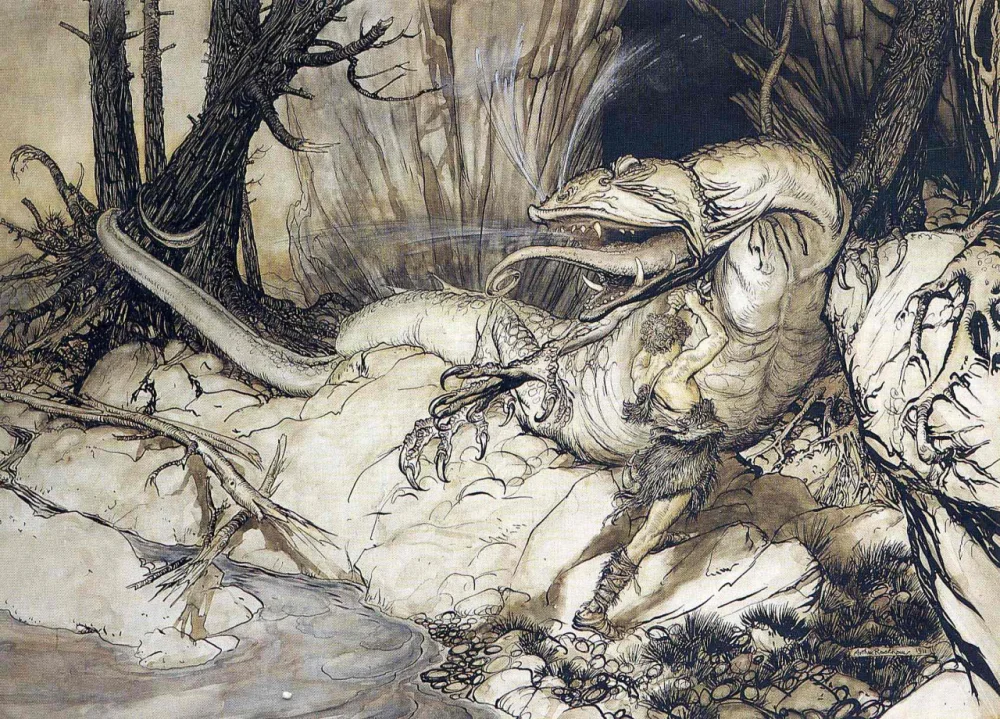

Heroic serpent · Hoard guardian
Fáfnir
Fáfnir guards the treasure that draws Sigurðr to Gnita-heath. His dying conversation belongs to the story as much as his monstrous form.
- Realm / setting
- Gnita-heath
- Attested in
- Völsunga saga, chapters XIV and XVIII
- Source status
- Medieval textual account
Creatures of the Dead
The dead do not share a single destination in these texts. Hel is both a figure and a name associated with the world of the dead; Níðhöggr appears in the poetry of death as well as at the tree’s roots. These are distinct source accounts, not a universal underworld bestiary.
Ruler among the dead
Hel
Snorri describes Loki’s daughter receiving authority over those sent to her, including people who die of sickness or old age.
- Realm / setting
- Niflheim; Hel’s domain
- Attested in
- Gylfaginning, Loki’s offspring
- Source status
- Medieval textual account
Shape-shifters and Enchanted Beings
Transformations are actions within stories, not a single species of creature. Loki changes form, while elves and dwarfs have their own textual identities. The illustrations below belong to different periods and should not be read as medieval field observations.
Shape-shifting figure
Loki
In the story of the master-builder, Loki takes the form of a mare. The episode leads to the birth of the eight-legged horse Sleipnir.
- Realm / setting
- The building of Ásgarðr’s wall
- Attested in
- Gylfaginning, the master-builder episode
- Source status
- Medieval textual account
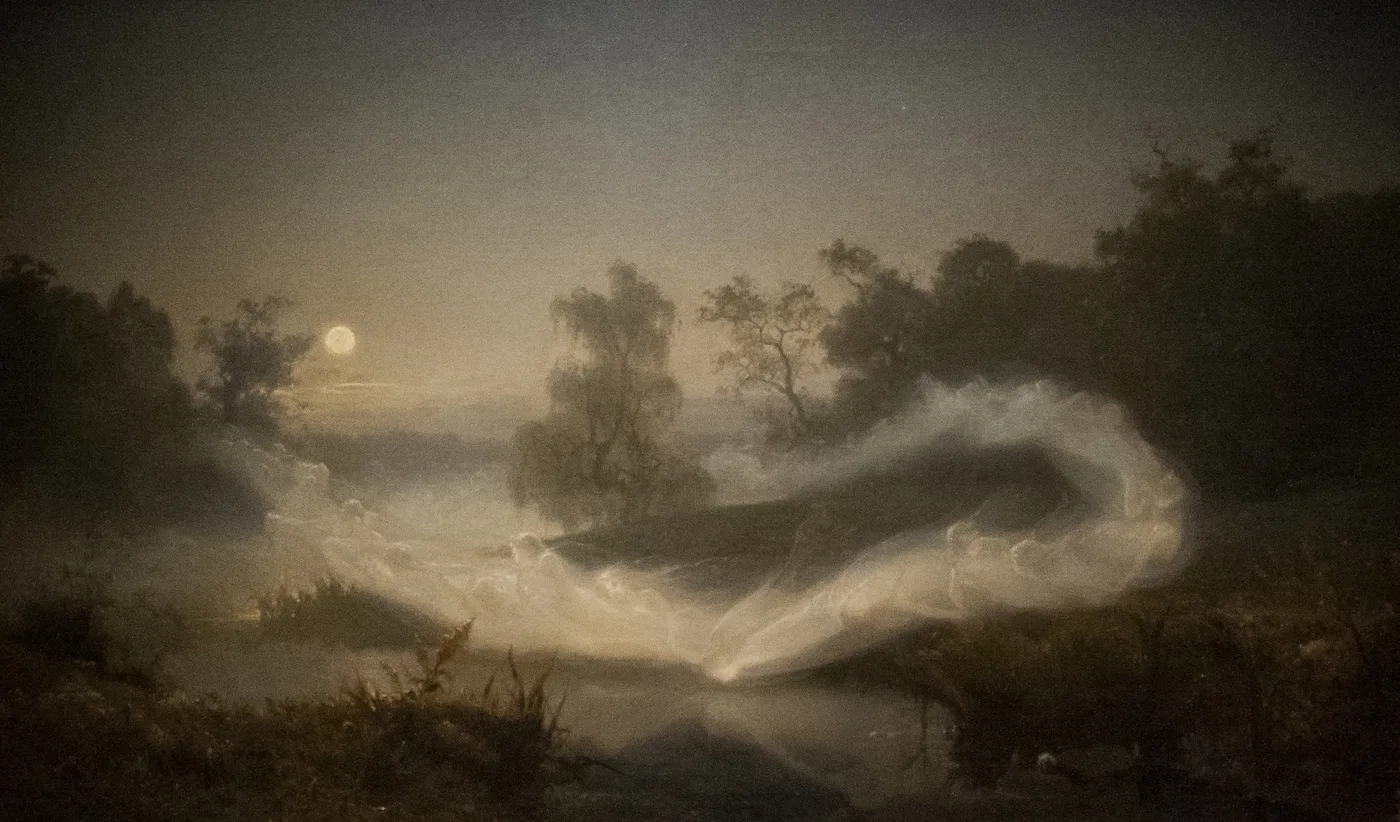

Enchanted beings · Ljósálfar
Light-elves
Snorri places the light-elves in Álfheimr. Later Scandinavian fairy imagery is a different layer of reception.
- Realm / setting
- Álfheimr
- Attested in
- Gylfaginning, the heavenly dwellings
- Source status
- Medieval textual account
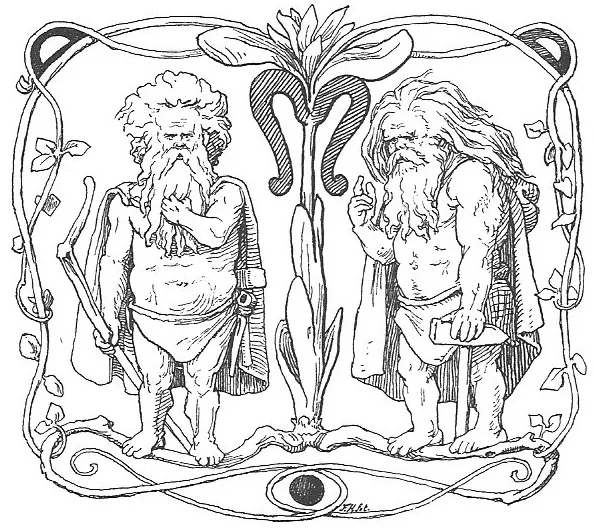

Enchanted beings · Dvergar
Norse dwarfs
The poems name many dwarfs; Snorri connects dwarfs with making extraordinary objects. Their identities come from specific passages.
- Realm / setting
- Earth and stone; the makers’ world
- Attested in
- Völuspá 9–16; compare the Prose Edda
- Source status
- Medieval textual account
Primary Texts
Start with the work, then check the passage and translation. The reading editions below are later English translations of medieval texts; their introductions and notes belong to the translators’ own time. Names and section numbering can differ between editions.
Poetic Edda
Anonymous poems preserved in medieval manuscripts, notably the 13th-century Codex Regius. Poem dates vary; the manuscript date is not the date of every tradition it contains. Consult Völuspá, Grímnismál and Fáfnismál for the beings in this guide.
Read Henry Adams Bellows’s English translation (1923) ↗Prose Edda
Snorri Sturluson’s 13th-century account of mythology and poetic language. Gylfaginning supplies many of the narratives below. Its learned framework and Christian setting matter when using it as evidence for earlier beliefs.
Read Rasmus B. Anderson’s English version (1901) ↗Völsunga saga
A medieval Icelandic heroic saga about the Völsung family and Sigurðr. Chapters XIV and XVIII in the linked translation describe Fáfnir’s treasure and his encounter with the hero. This is a saga witness, not a modern dragon taxonomy.
Read William Morris and Eiríkr Magnússon’s English translation (1888) ↗
Later Art and Retellings
The manuscript drawing of Níðhöggr is a 17th-century witness to later reception, not a Viking Age image. Bauer’s Fenrir (1911), Frølich’s dwarfs (1895) and Malmström’s dancing elves (1866) offer other, explicitly later visual worlds. Each reproduced image links to its public-domain source record.
Rackham’s Fáfnir (1911) illustrates the Wagnerian tradition, not the medieval saga directly. William Morris’s The Story of Sigurd the Volsung (1876) is likewise a literary retelling, distinct from his co-translation of Völsunga saga.
The panorama and ornamental portraits made for this guide are original modern illustrations. Their branching tree, interlace and imagined stone, bronze and parchment frames evoke a northern manuscript atmosphere; they are not facsimiles or evidence for historical appearance.