Old Norse heroic tradition · medieval Icelandic texts
Fáfnir
Transliteration / Latin-script form: Fafnir (diacritics omitted; Old Norse already uses the Latin alphabet)
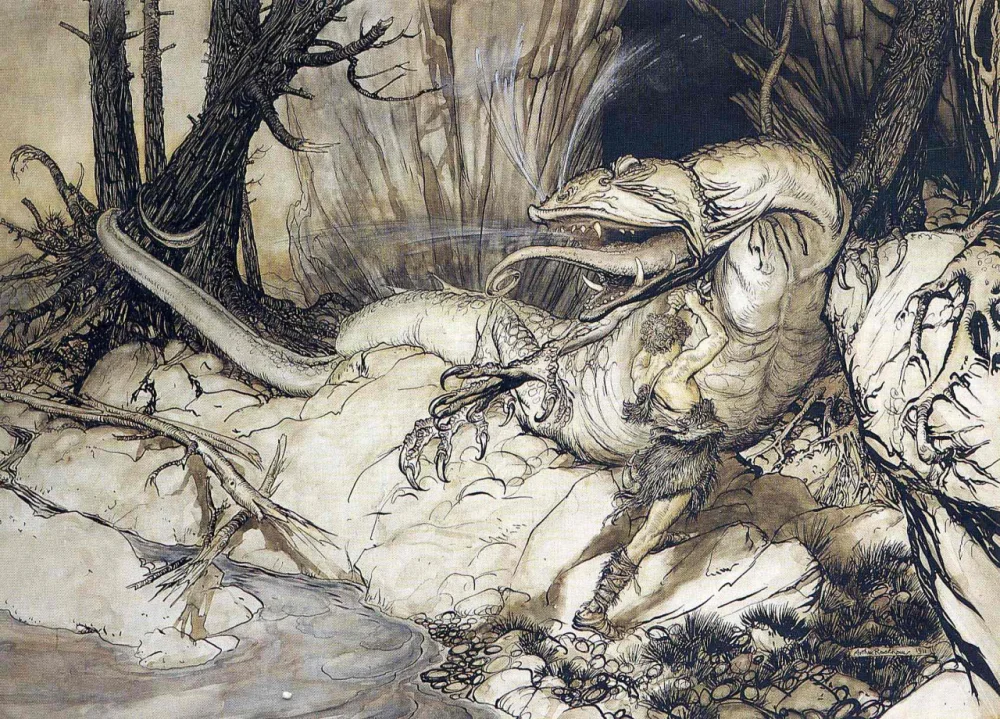

Image provenance
- Culture
- British illustration of German Wagnerian drama
- Collection
- Digitised book plate on Wikimedia Commons; original artwork location not recorded
- Work number
- No accession number recorded; Commons file: Siegfried kills Fafnir.jpg
- Source relation
- Illustrates Wagner’s adaptation, not the medieval Völsunga saga. It is not a secure anatomical reconstruction.
Identity
- Name
- Fáfnir
- Alternative names
- Fafnir; Fafner in Wagner’s later German adaptation (a distinct retelling).
- Tradition
- Old Norse heroic legend; the Sigurd cycle.
- Oldest attested source
- The earliest witness is not securely ranked here. The medieval Eddic Fáfnismál is a principal textual witness; the Ramsund carving (11th century) attests the Sigurd episode earlier than the surviving saga manuscripts. Image dates and poem composition dates are different kinds of evidence.
- Main texts
- Fáfnismál; Völsunga saga, chapters XIV and XVIII–XIX. This sheet follows Morris and Magnússon’s English translation, 1888 edition.
| Dragon terminology | Historical translation — The Morris–Magnússon English translation uses worm, lingworm, drake, and dragon. The English label here follows that edition, not a universal serpent classification. |
|---|
Form described by sources
- Body
- Worm-like / serpentine vocabulary; a quadrupedal body is not established (XVIII).
- Wings
- Not stated; absence of a description does not prove winglessness.
- Limbs
- Number not stated. A left shoulder is mentioned (XVIII).
- Size
- Great track and earth-shaking movement. No precise body length; thirty fathoms refers to a cliff (XVIII).
- Colours
- No body colour specified in the selected passages.
- Voice
- Roars and speaks with Sigurd (XVIII).
- Intelligence
- Reasons, questions his killer, and warns about the hoard (XVIII).
- Shapeshifting
- Becomes a worm after taking the gold (XIV); repeated or reversible shapeshifting is not established.
Domain
- Attested
- Treasure: Andvari’s hoard. Setting: Gnita-heath and a path to water.
- Not attested
- No rule over water, sky, mountain, underworld, storm, death, fertility or royal authority is established by these passages. Drinking water is not water sovereignty.
Narrative role
- Attested
- Hoard guardian; Sigurd’s antagonist; transformed creature.
- Not attested
- Not identified here as a deity, ancestor, rain-bringer or cosmic force. His death is an event, not a divine office.
The story
Fáfnir kills his father and takes the gold that should have compensated the family for his brother’s death. He becomes a terrible worm and withdraws with the hoard to Gnita-heath. Regin sends Sigurd against him. Hidden in a pit beneath the dragon’s path to water, Sigurd strikes upward with Gram. Dying, Fáfnir warns his killer that the treasure will bring ruin. Victory transfers the hoard, but does not lift its curse.
What the source actually says
Reading basis: Völsunga saga, Morris–Magnússon translation, 1888 edition, chapters XIV and XVIII. XIV places the transformation after the murder and seizure of the hoard. XVIII describes crawling, venom, a roar, head and tail, and a wound beneath the left shoulder. That shoulder is textual evidence, but not a count of legs. Wings and body colour are not specified. The reported thirty fathoms measures the cliff at the watering place, not a stated body length. Fáfnir’s dialogue demonstrates reasoning and foreknowledge; it does not establish omniscience. These are observations about this translation, not a critical edition of every Old Norse witness.
Consult texts and references ↓Iconographic evolution
Dated witnesses and later reception; gaps are not evidence of a continuous visual tradition.
- Ancient text · no secure witness cited
An ancient written Fáfnir source is not established by this record. Do not backdate the surviving medieval texts.
Read source ↗ - 11th century · carved stone
Ramsund, Sö 101: Sigurd strikes the serpent from beneath. A historical witness to the episode, not a zoological diagram.
Read source ↗ - Medieval manuscript · Eddic poetry
Codex Regius, GKS 2365 4to, preserves Eddic poetry. A textual witness must not be presented as a painted portrait.
Read source ↗ - Engraving · gap in this record
No verified Fáfnir engraving is catalogued here. No image is supplied to manufacture a missing stage.
Read source ↗ - 1911 · colour illustration
Rackham’s book plate illustrates Wagner’s drama. Its anatomy belongs to that later artistic treatment.
Read source ↗ - Modern reinterpretations · separate branch
Wagnerian and subsequent retellings belong to reception history. This profile makes no catalogue of contemporary franchises.
Read source ↗
Texts & references
- 1 · Völsunga saga
Anonymous; translated by William Morris and Eiríkr Magnússon. Walter Scott Press, London, 1888. Chapters XIV, XVIII and XIX; the primary reading basis of this profile.
Read source ↗ - 2 · Medieval Eddic witness
Árni Magnússon Institute: Konungsbók Eddukvæða, GKS 2365 4to. Manuscript reference for the Eddic tradition; not an assertion of a securely dated first composition.
Read source ↗ - 3 · Ramsund image witness
World-Tree Project, Sigurd on the Ramsund rock carving. Comparative visual evidence for the medieval heroic episode.
Read source ↗ - 4 · Later literary reception
William Morris Archive, University of Iowa, editorial introduction to Sigurd the Volsung. Keep retellings separate from the saga reading.
Read source ↗